
Vienna. One could argue that the experience of exile is so constitutive of the art world that it may even be considered a structural element: residencies, guest artists, curators, critics — people born in one place and active in another, keeping the art world in motion. But not every exile carries the same weight; in this respect, the art world is rather banal.
Political migration is a serious matter, while economic migration is commonplace. Artists have always moved to centers of economic power in order to make a living. When an “ordinary” migrant is elevated to the status of exile, it can become a career step that provides her or him, those who write about their work, and the institutions that exhibit it with a license and a label they can exploit.
What kind of exile is the photographer Jitka Hanzlová, whose exhibition Identities occupied most of the summer–autumn season at the Albertina? As she recounts in concise and unvarnished words, her escape from Czechoslovakia in 1982 began as a holiday in Germany. Visiting a local market, she noticed the abundance of fruit and the vividness of colors, so much so that everything seemed possible — so many future perspectives from which to choose that she decided to stay and assume the identity of an artist, albeit only several years later.
The institutional reception of her art — the series of curatorial texts that have accompanied her career for a quarter of a century — does not entirely support this narrative.
It remains vague yet controlled: exile is framed as constitutive of the artist’s practice. Walter Moser, the chief curator, is particularly generous with synonyms — “expulsion,” “flight,” “homelessness” — and many bleak “socialist undertones” permeate his portrayal of Hanzlová’s art, drawing a curtain (naturally an iron one) over her lens. The artist is in a “mute state of exile,” as another critic observed, so that we may understand her camera as a tool of access and connection rather than a weapon unleashed upon the world.
How much power can artists in exile wield, and can they sometimes be wrong? For those not initiated into the narrative, the exhibition answers the latter — loudly, if not unanimously. Ten series are on display: some portraits, some nature photographs, others combining both. There is only one size and format: the vertical portrait on a sheet of paper. Each is a record of an experience, says Hanzlová, and much can be derived from this disciplined consistency. “I do not hunt, I gather,” she declares, rejecting the idea that her practice is driven more by power than by experience. “Photographs document sequences of consumption by turning experiences into consumable images,” Susan Sontag once wrote, and today everyone knows that this experience economy is real. But Hanzlová’s declaration, I would argue, was only half true.
In the portrait series Females (1997–2000) and Brixton (2002), Hanzlová photographs anonymous women encountered on the streets of unfamiliar cities. She calls these encounters “bubbles” and stages them as meetings between equal partners. There is little context, but clearly a degree of consent. Or rather, there was a form of consent typical of the turn of the millennium toward a female artist. But how could these individuals have known that the “bubble” would burst and their images would live on long after their disappearance? There was certainly no “contract” for the encounter — to use Ariella Azoulay’s thought — no ethical recognition of a third party outside the “bubble”: the audience, whose curious gazes, as here in the Albertina, would fall upon them decades later.
Untitled, serialized, typological — women presented in a uniform format and strict linear sequence in an exhibition titled Identities? Frontal, evenly lit, instructed to show no emotion. In resisting this expressionless aesthetic, I found myself rooting for these women, searching each for a twitch, a half-clenched fist, a shift from caution to confrontation. Then I returned to my first impulse in this imposed encounter — the only ethical one — to look away. This is ethnographic photography. The curators may reject this relational ontology of photography, but is it not somewhat disingenuous to conceal it entirely from a blockbuster audience?
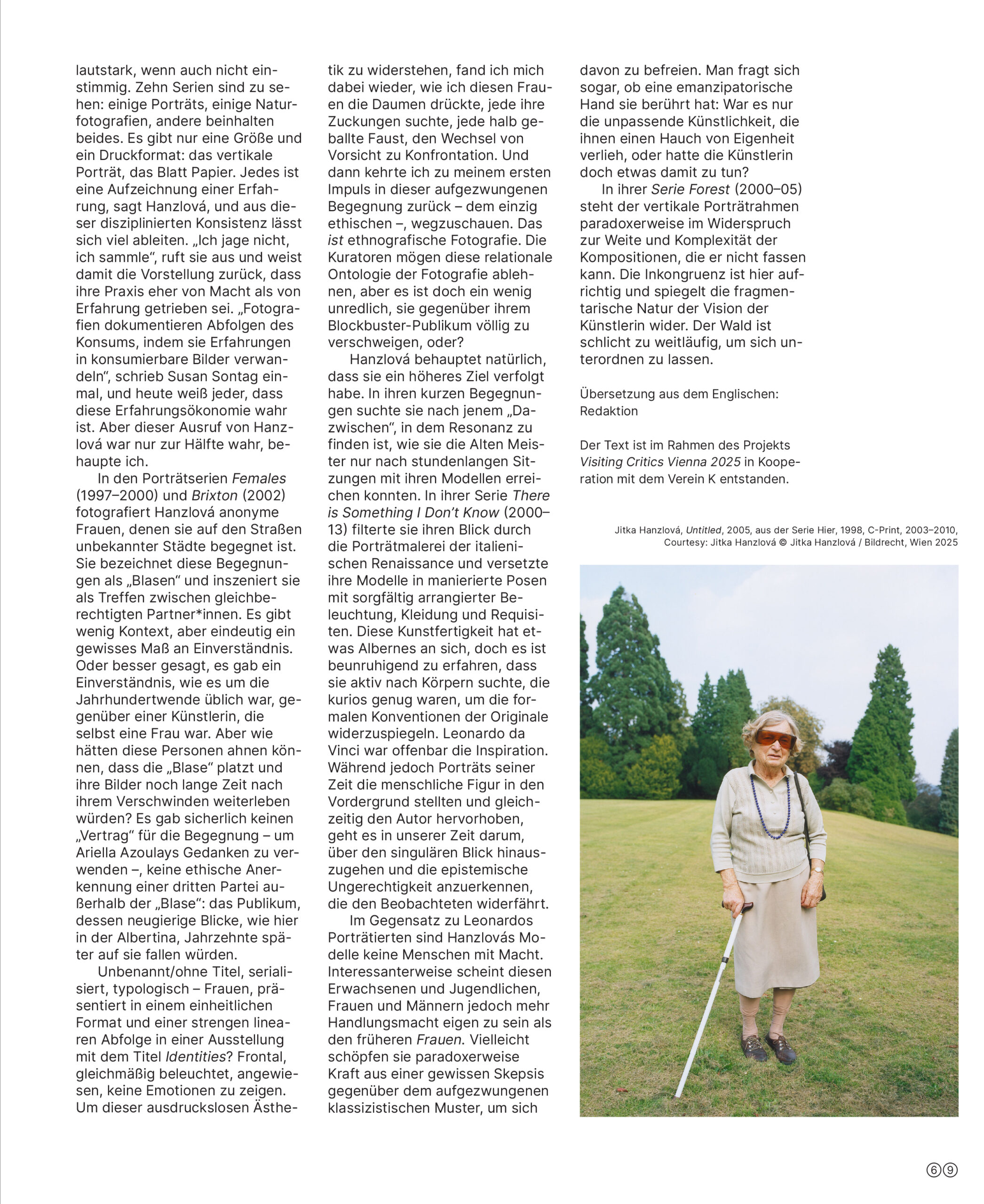
Hanzlová, of course, claims to have pursued a higher goal. In her brief encounters, she sought that “in-between” where resonance can be found, as the Old Masters could achieve only after hours of sittings with their models. In the series There is Something I Don’t Know (2000–13), she filtered her gaze through Italian Renaissance portraiture, placing her models in mannered poses with carefully arranged lighting, clothing, and props. There is something slightly absurd about this artistry, yet it is unsettling to learn that she actively sought bodies curious enough to mirror the formal conventions of the originals. Leonardo da Vinci was clearly an inspiration. While portraits of his time foregrounded the human figure and highlighted authorship, our era demands moving beyond the singular gaze and acknowledging the epistemic injustice inflicted upon the observed.
Unlike Leonardo’s sitters, Hanzlová’s models are not people of power. Interestingly, however, these adults and adolescents, women and men, seem to possess more agency than the earlier women. Perhaps paradoxically, they draw strength from a certain skepticism toward the imposed classicist pattern in order to free themselves from it. One even wonders whether an emancipatory hand touched them: was it merely the ill-fitting artificiality that granted them a trace of individuality, or did the artist herself play a role?
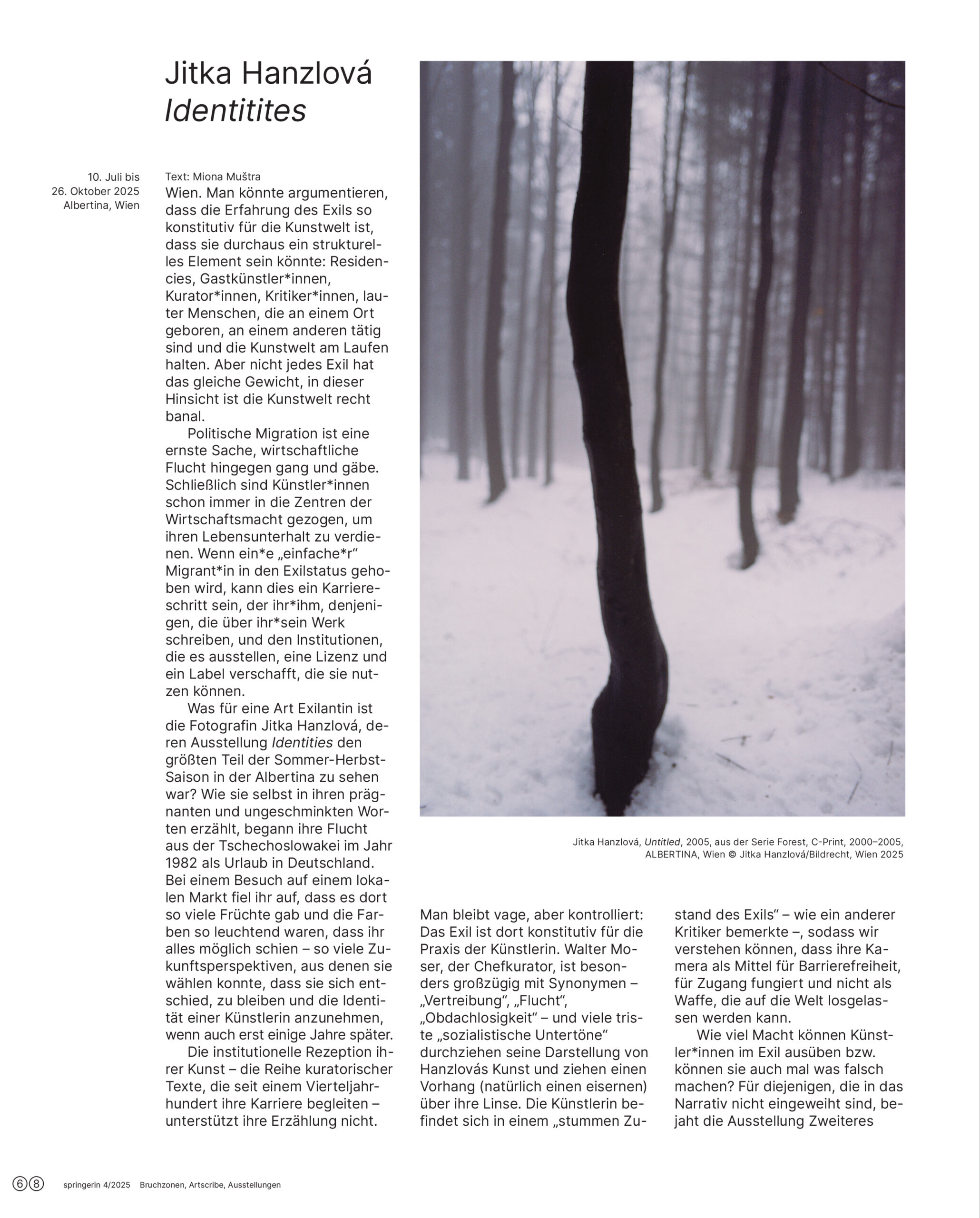
In the series Forest (2000–05), the vertical portrait frame paradoxically contradicts the vastness and complexity of compositions it cannot contain. The incongruity is sincere here and reflects the fragmented nature of the artist’s vision. The forest is simply too expansive to be subordinated.
*The text was produced within the framework of the project Visiting Critics Vienna 2025 in cooperation with Verein K.